
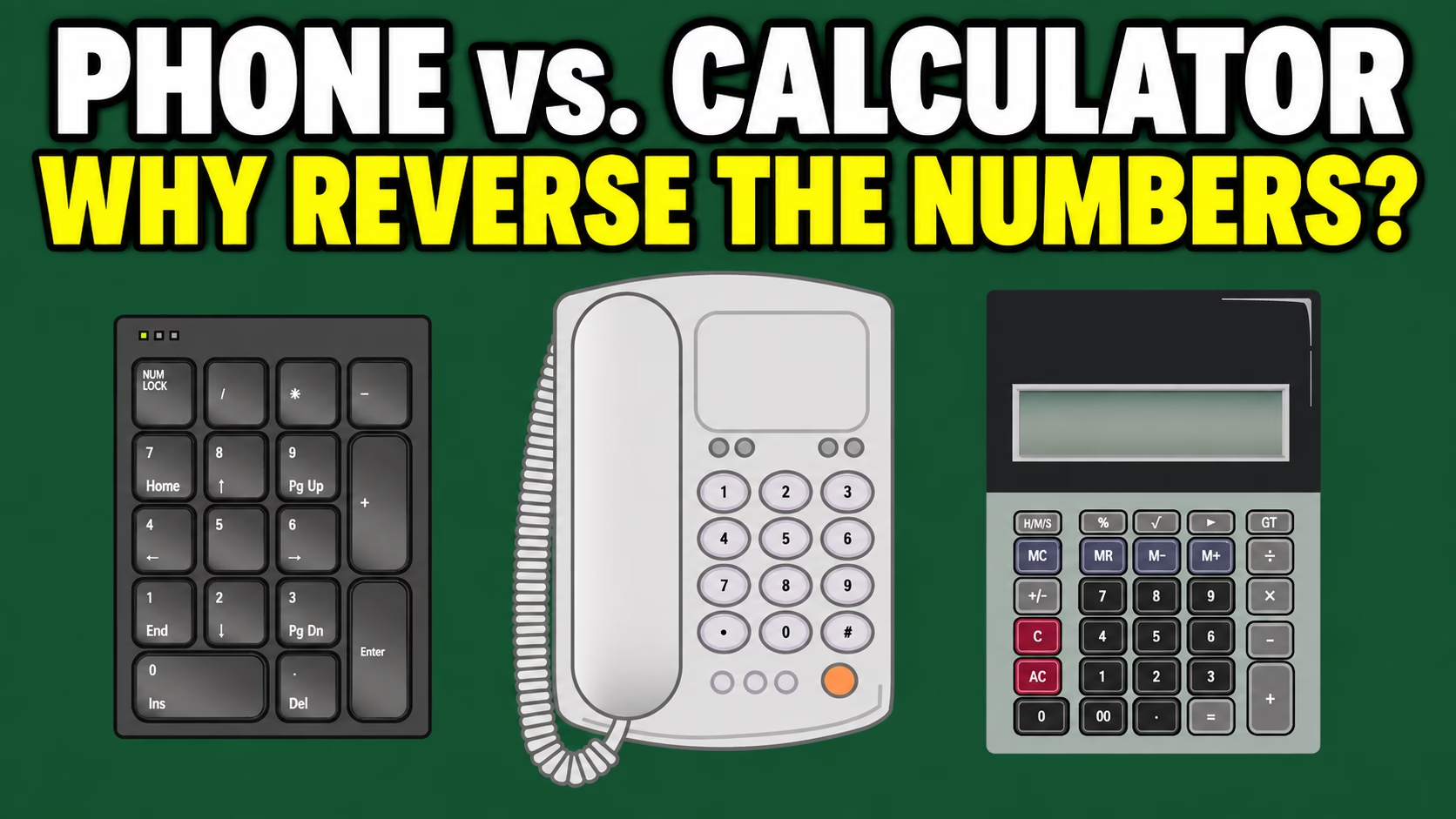
Compare a telephone keypad with the number pads on a calculator and a keyboard. Their shapes are similar, yet the phone’s numbers are arranged in the opposite order. Why is the telephone keypad different?
Where the calculator layout came from
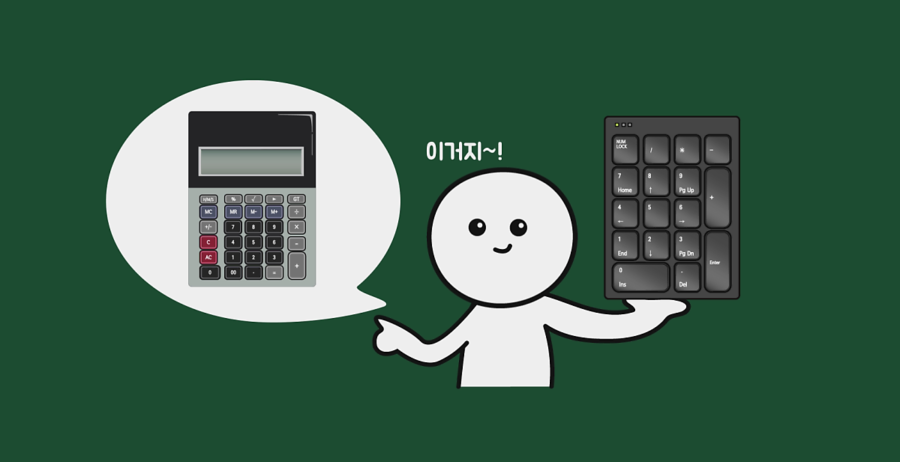
There are several explanations. The calculator layout shown here began with a calculating machine developed by Sundstrand in 1911. Like today’s calculators, it placed 0 at the very bottom and 7–8–9 at the top.
This arrangement is thought to have come from cash registers of the late nineteenth century. If you use a calculator, you may find the reasoning familiar: smaller numbers tend to be used more often, so putting 0 close to 1, 2 and 3 is convenient. The layout makes practical sense. So why is the telephone’s arrangement reversed?
The history of telephones runs from magneto phones to common-battery phones, automatic telephones, internet phones and smartphones. Early automatic telephones used rotary dials. Turning the dial wound a spring; as it returned to its starting position, it operated contacts to generate signals. These pulses identified the number and placed the call.
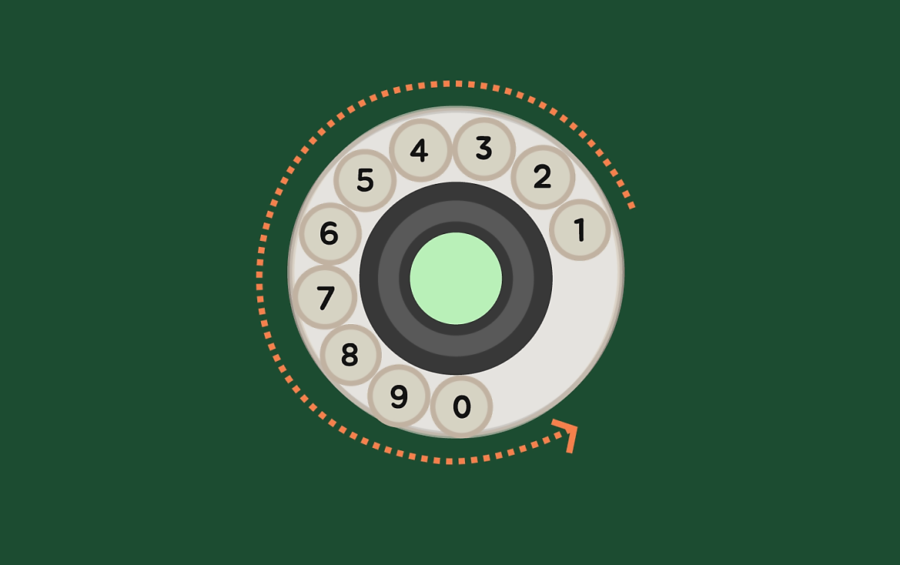
The order on a rotary telephone
With this method, zero cannot be represented by zero pulses. So 0 was placed after 9, effectively using 10 to represent 0. Following that rule, telephone numbers were arranged in the order 1–2–3–4–5–6–7–8–9–0 (=10).
On a rotary telephone, 1 is at the upper right and 9 is at the lower left. Translating that arrangement directly into push-button keys would produce the odd-looking layout below. One explanation is that 1, 2 and 3 were therefore placed at the top, with 7, 8, 9 and 0 below.
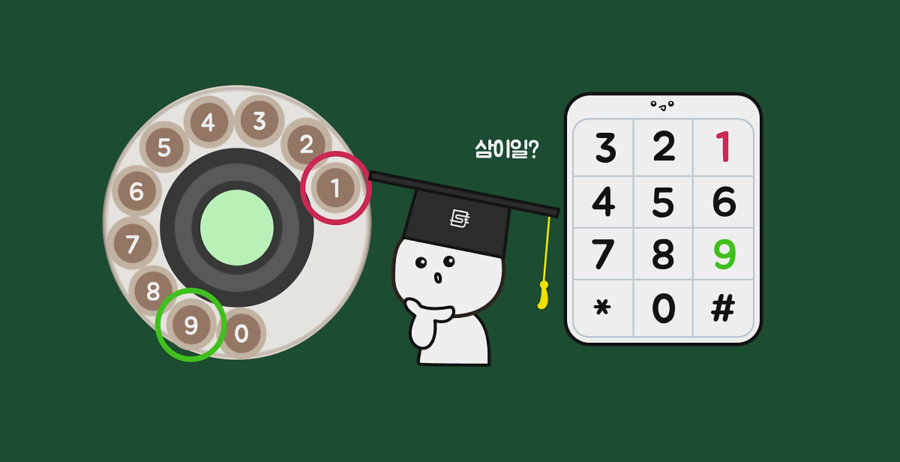 3, 2, 1?
Bell Labs tested different keypad layouts
Another explanation is that the arrangement was selected through experiments at Bell Labs, the developer of the push-button telephone, to find the best keypad layout.
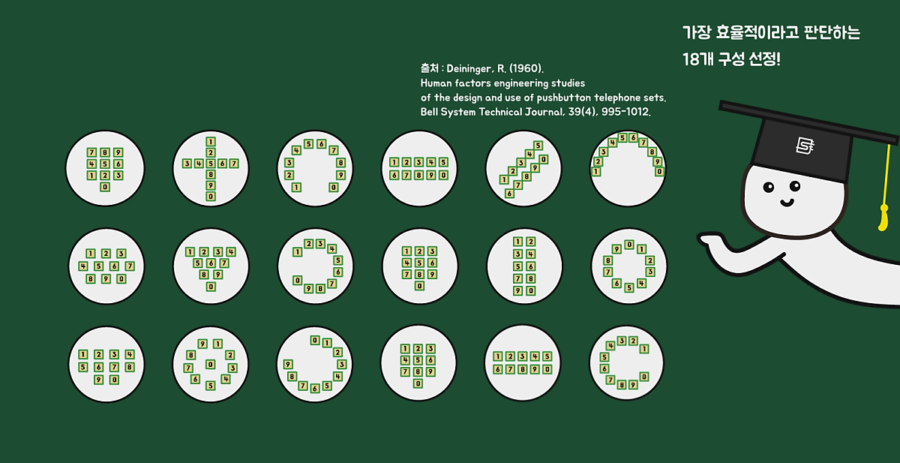 18 layouts selected as
the most efficient!Source: Deininger, R. (1960).
Human factors engineering studies
of the design and use of pushbutton telephone sets.
Bell System Technical Journal, 39(4), 995–1012.
Bell Labs carried out several experiments to find the best telephone keypad among 18 arrangements. It narrowed the choices to five, but there were no significant differences in entry speed or accuracy. The arrangement preferred by the most people was a keypad with two rows.
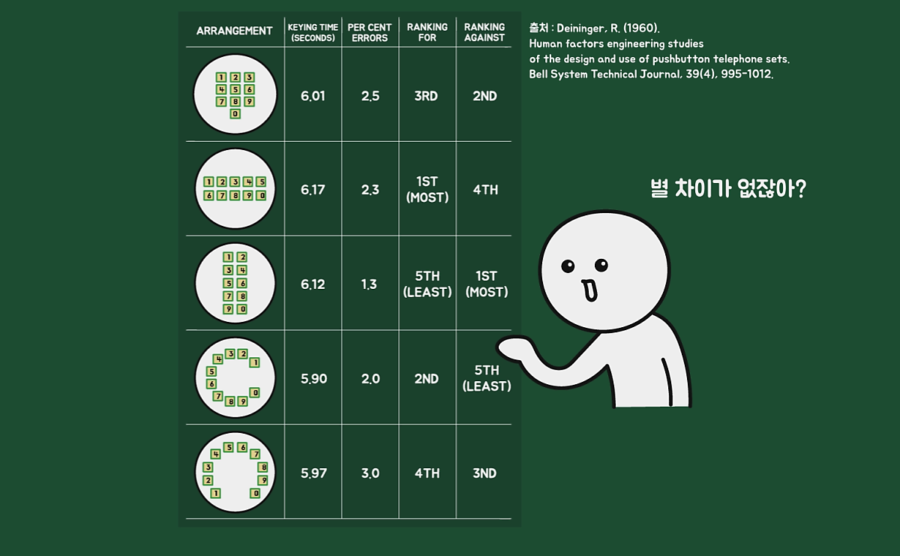 Source: Deininger, R. (1960).
Human factors engineering studies
of the design and use of pushbutton telephone sets.
Bell System Technical Journal, 39(4), 995–1012.Not much difference, right?
For engineering and other reasons, however, the two-row keypad was ruled out. The layout with 1–2–3 at the top, which had high accuracy, was selected. Linking the keys to alphabetical order probably also influenced the choice.
 This one!
Why keyboards followed calculators
When a number layout had to be chosen for keyboard numeric keypads, the calculator arrangement was reportedly selected. That is why keyboards and calculators have matching layouts while telephone keypads run in the opposite order. Has that answered your question?
Copyright. 사물궁이 잡학지식. All rights reserved
More English articles · Read the original Korean article
Watch the original video below. For English subtitles, turn on captions (CC) and choose English (United States) in the player settings. You can also select the original Korean audio under Audio track.