

Wave your hand through empty space. It may seem as if nothing is there, but there is actually air. The empty spaces around us on Earth are filled with it. Outer space, beyond Earth, has no air—so what fills that vast universe?
We will explore this question through portions of The Comfort of Astronomy (『천문학이라는 위로』), a book by Professor Ho Seong Hwang of the Department of Physics and Astronomy at Seoul National University.
Dark matter and dark energy fill the universe
Space contains stars, galaxies, planets, artificial satellites, and more. Yet these familiar things account for only about 5% of the universe’s total mass or energy. What makes up the other 95%? Astronomers have found that dark matter accounts for about 25%, while dark energy accounts for about 70%.
 25%
25%Dark matterUniverse70%
Dark energy
The definitions of dark matter and dark energy are still rather elusive:
Dark matter: Matter that does not emit light and cannot be seen, but whose presence is inferred from its gravitational effects. Its identity is still unknown.
Dark energy: A hypothetical form of energy thought to be distributed throughout space and to drive the universe’s accelerating expansion.
Even so, scientists are confident of their existence because of evidence from many different observations.
Compare a carousel with the solar system
To understand the evidence for dark matter, let’s look at several graphs. The first shows how fast carousel horses move at different distances from the center.
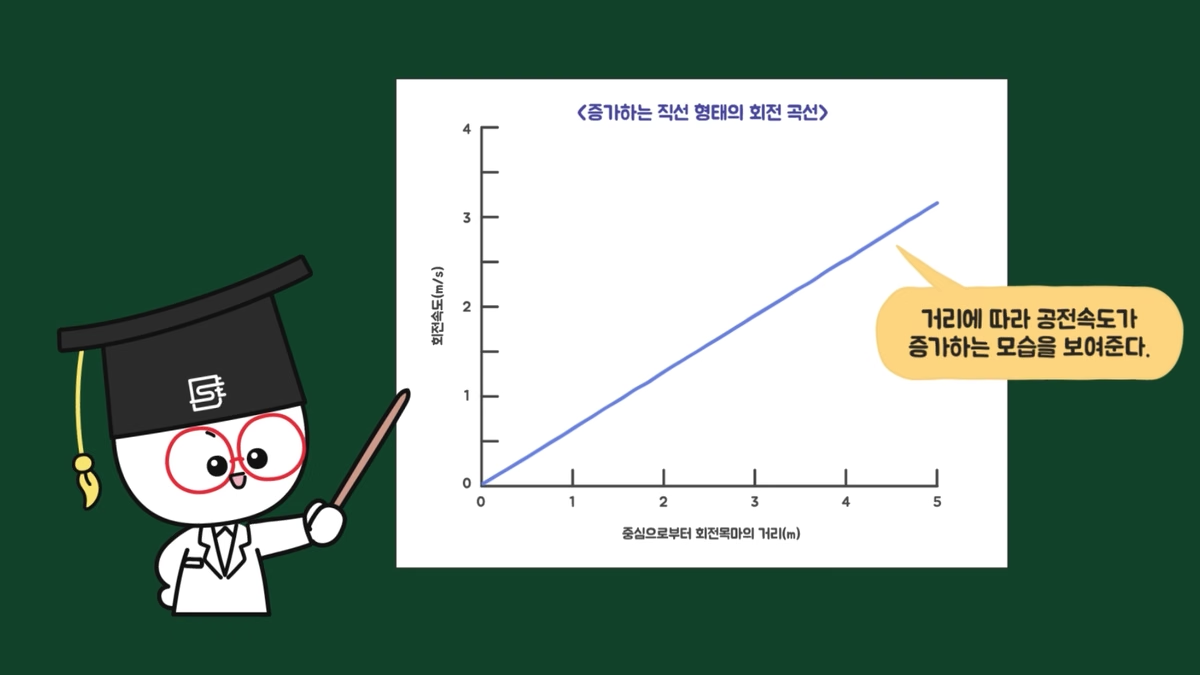 Carousel rotation curveSpeed (m/s)Distance from center (m)Speed increases
with distance.
A carousel’s platform rotates as a single piece, so every horse completes a full turn in the same amount of time, regardless of its distance from the center. Horses farther out therefore travel faster. That is why the graph rises in a straight line.
The next graph shows how fast the planets in our solar system orbit at different distances from the Sun.
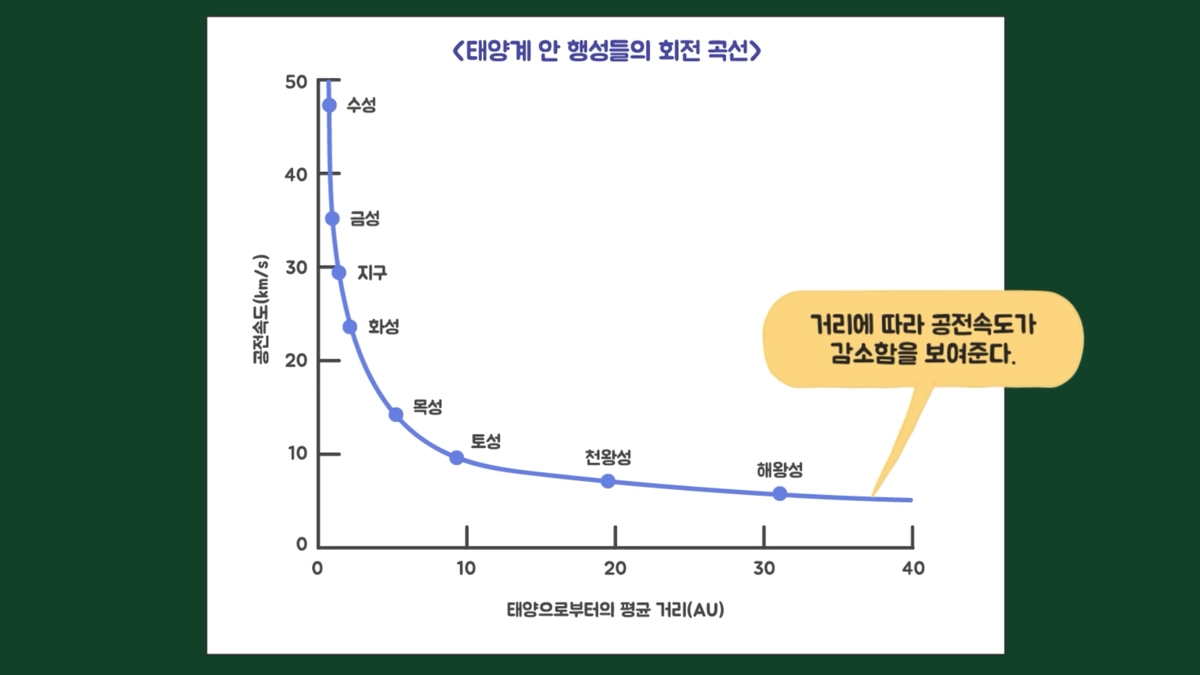 Solar system rotation curveSpeed (km/s)Average distance from Sun (AU)MercuryVenusEarthMarsJupiterSaturnUranusNeptuneOrbital speed decreases
with distance.
Planets closer to the Sun move faster. Unlike carousel horses, they are not attached to a platform. They orbit the Sun because its powerful gravity holds them in orbit.
Galaxy rotation curves reveal unseen mass
Now look at the speeds of stars in the Milky Way at different distances from the galactic center. The pattern is different from the graphs above.
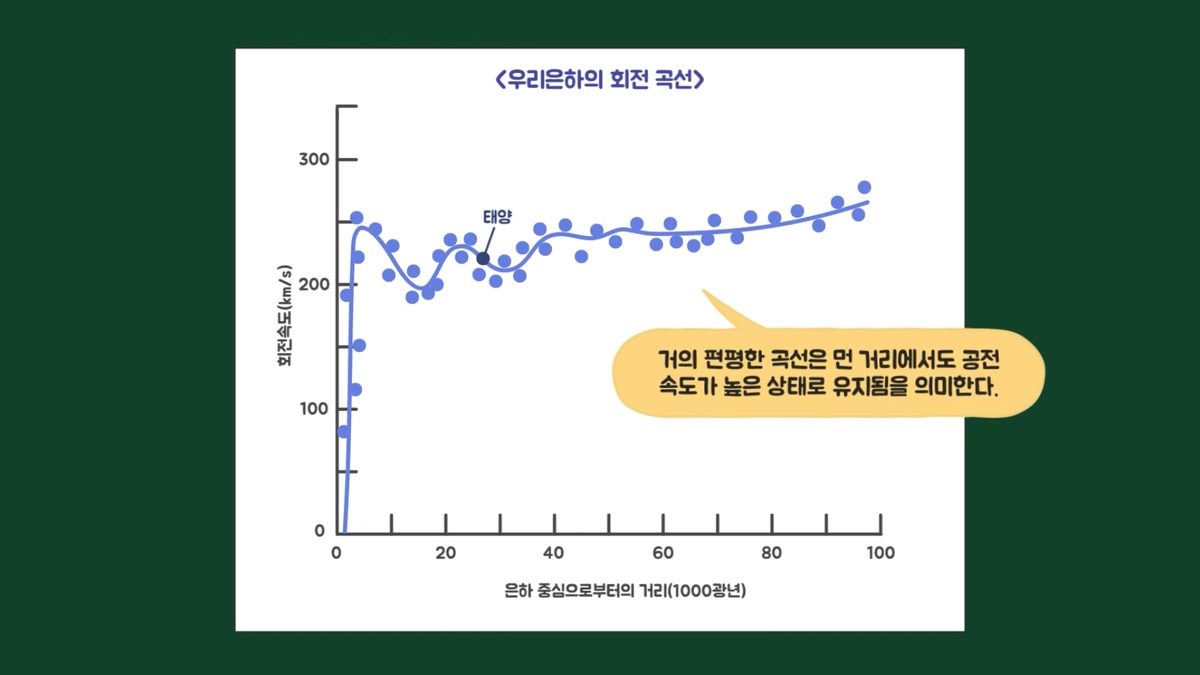 Milky Way rotation curveSpeed (km/s)Distance from center (1,000 light-years)SunThe nearly flat curve shows high
orbital speeds even far from the center.
If we predict stellar speeds using only the visible matter and the laws of gravity, stars farther out should move more slowly. In reality, the outer stars continue moving at high speeds. Other spiral galaxies show similar patterns.
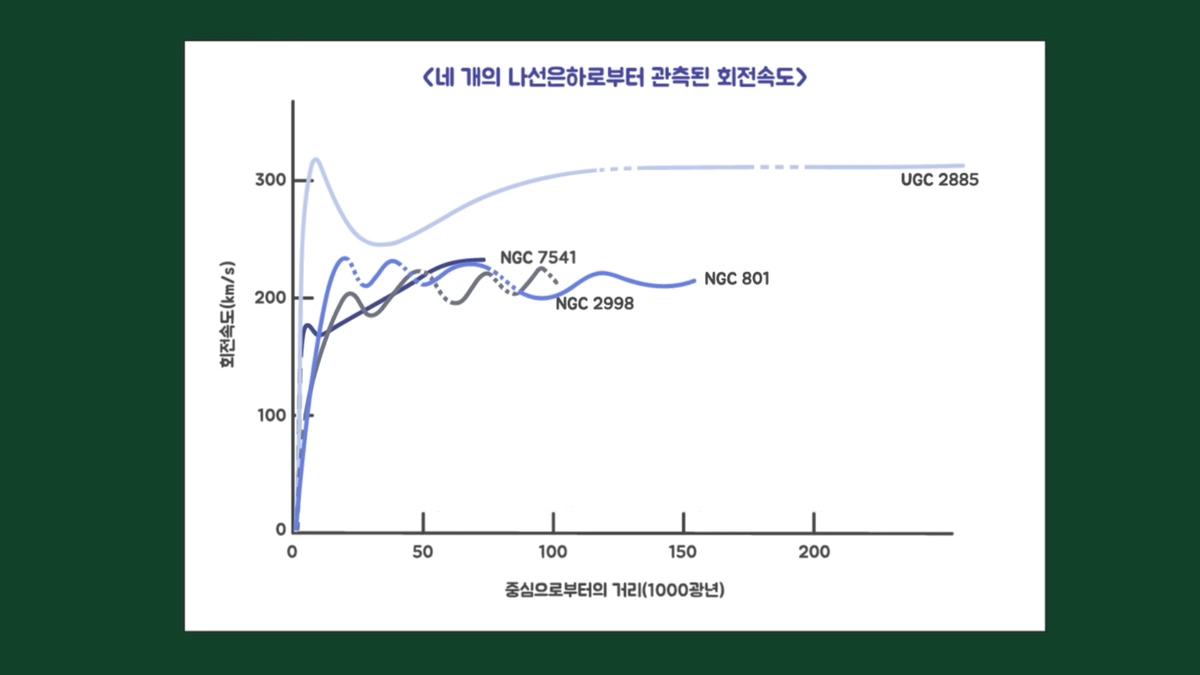 Rotation curves of four spiral galaxiesSpeed (km/s)Distance from center (1,000 light-years)
This suggests that, throughout a galaxy, there is unseen mass in addition to the mass we can see. Its gravity makes the stars orbit faster. We call this material dark matter.
Galaxy cluster motions and gravitational lensing provide other lines of evidence. But galaxy rotation curves are among the most intuitive, easy-to-understand illustrations of dark matter’s existence.
What could dark matter be? WIMPs and axions
So what exactly is dark matter? Its identity has not yet been established, but there are two candidates to consider.
The first is a hypothetical particle called a WIMP. Theory predicts that it could very rarely collide with ordinary matter and leave a tiny trace. Experiments place ultrasensitive detectors deep underground to search for those rare traces.
 WIMPWIMP: Weakly Interacting Massive Particle
The second is the axion, an extremely light and tiny hypothetical particle. It was originally proposed to solve a puzzle in quantum mechanics, but its properties also fit dark matter, making it a leading candidate.
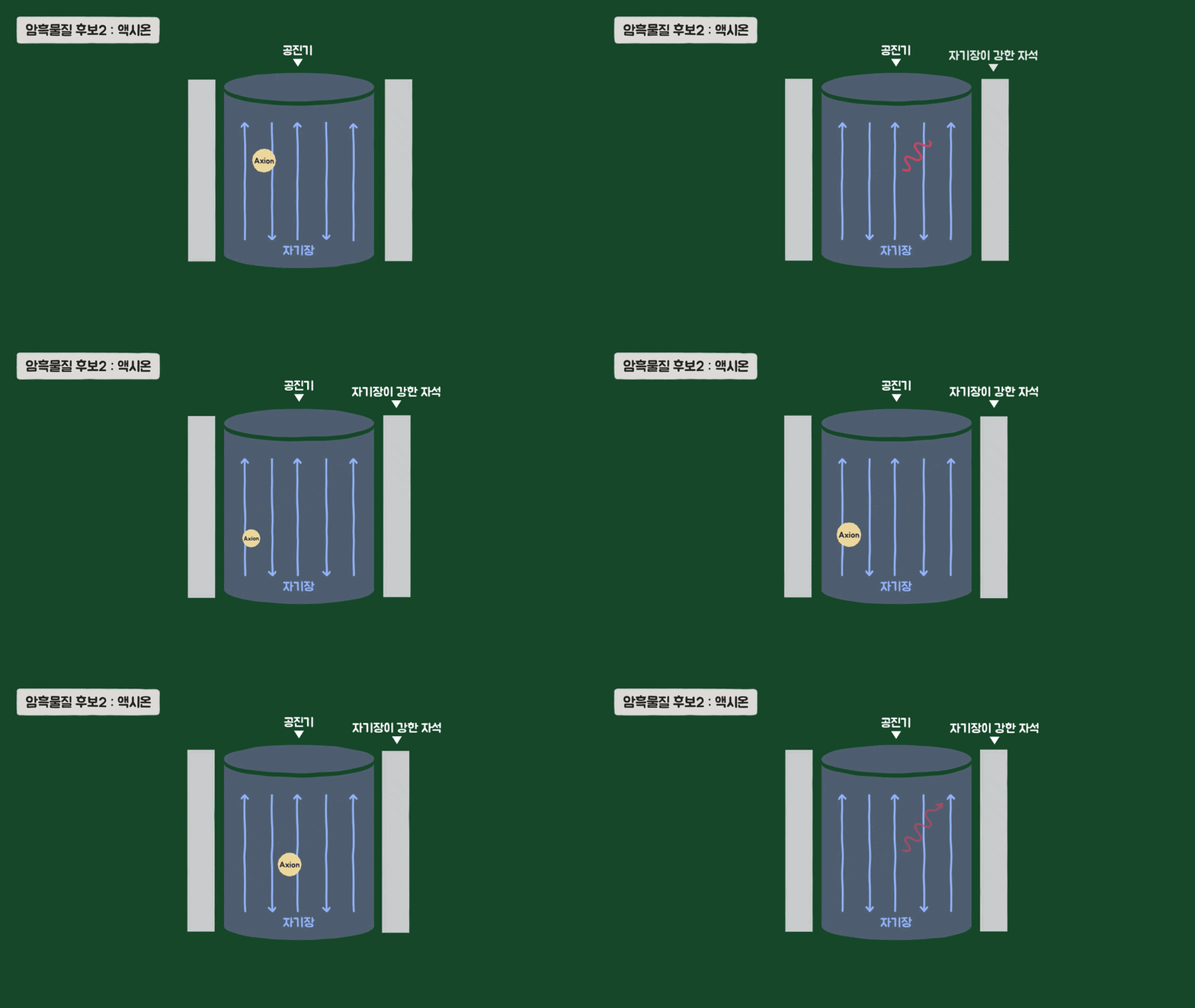 Dark matter candidate: axionCavityStrong magnetMagnetic
field
Axions are predicted to interact very weakly with electromagnetic fields. Experiments around the world use powerful magnetic fields to try to detect them.
Although dark matter’s existence is accepted, its identity remains a mystery. Discovering what it is would be an achievement important enough to merit a Nobel Prize.
Dark energy and the accelerating universe
How did scientists learn about dark energy? In 1998, observations of distant supernovae revealed something astonishing: the universe was not merely expanding. Its expansion was accelerating.
The expectation at the time was that gravity would gradually slow the expansion. Instead, it was speeding up. Scientists inferred that a repulsive effect was at work and called the energy responsible for it dark energy.
This observation does not directly prove dark energy’s existence. Its existence is accepted because the phenomenon cannot be explained without the concept in this account. Scientists continue to investigate this mysterious force through more precise supernova observations and computer simulations.
We have explored the components that make up 95% of the universe. We know they exist, yet we do not know what they are. That is fascinating in itself. Has your curiosity been satisfied?
Featured book: The Comfort of Astronomy (Korean edition) — Kyobo Book Centre · Yes24 · Aladin
Research and consultation: Professor Ho Seong Hwang, Department of Physics and Astronomy, Seoul National University.
Copyright. 사물궁이 잡학지식. All rights reserved
More English articles · Read the original Korean article
Watch the original video below. For English subtitles, turn on captions (CC) and choose English (United States) in the player settings.
